
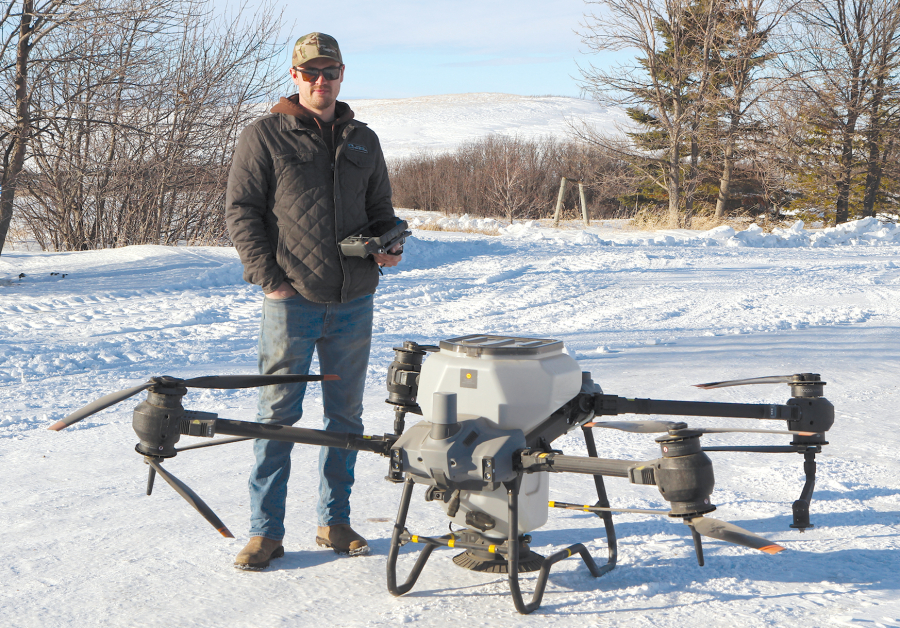
On their farm, the Thomas’ practice min-till and want as much grazing as possible to cut down on feed costs for their cattle, so planting a cover crop amongst their main crop was a no-brainer. By inter-planting forage broadleaves and grasses between the rows of grain, it allows them to reap the many benefits of cover crops like preventing topsoil erosion and weeds, depositing nutrients into the soil, and an additional and novel food source for cattle, which keeps them grazing for longer, giving them more opportunity to drop their own nutrients.
“Our problem here in Manitoba is our short growing season,” said Thomas. “Down south, farmers can plant their main and cover crops separately, but up here we run into frost. The drone makes it possible to do in-crop applications so that our cash crop can get a jump the cover crop.”
In addition, once a farmer gets the hang of programming the drone’s flight path, there are even more benefits. According to Thomas, the software is fairly user-friendly, but it helps to be a little bit tech-savvy to fully utilize the machine’s capabilities. Everything is programmed in the remote, with options to fly around obstacles and even to stop broadcasting seed in areas like sloughs. It also works well if some areas in a field need to be seeded at different times due to standing water. Thomas suggests making the flight path as efficient as possible, since lots of starts and stops can drain the batteries.
As with many new technologies, right now the benefits come with a large investment. In addition to the first drone, Thomas’ dad also purchased a second one to make large applications quicker, an enhanced GPS base station to make flight paths more efficient, a large generator to charge the batteries and a trailer to haul them around. However, he said that likely by the end of the second year it will have paid for itself.
Thomas also had to take a two-day course offered by the company that created the drone, as well as pass an exam from Transport Canada. Even though the drone only typically flies 10 to 20 feet off the ground, operators need to know the rules to share the sky safely.
While the original application for the drone was intended to be spraying, common chemicals are still considered off-label in Canada, but while farmers wait for legislation to catch up, the machine itself will continue to evolve, getting bigger and better for broadcasting seeds across the large fields here in the prairies.
Even with the investment and initial learning curve, between cutting down on feed costs for cattle and all the custom work for other farmers he’s been able to provide, it’s been a boon for the family.
“It’s really opened up a new avenue for us,” he says. There wasn’t really a good way to do it before this.”
by JACQUIE MAYNARD, Recorder staff