
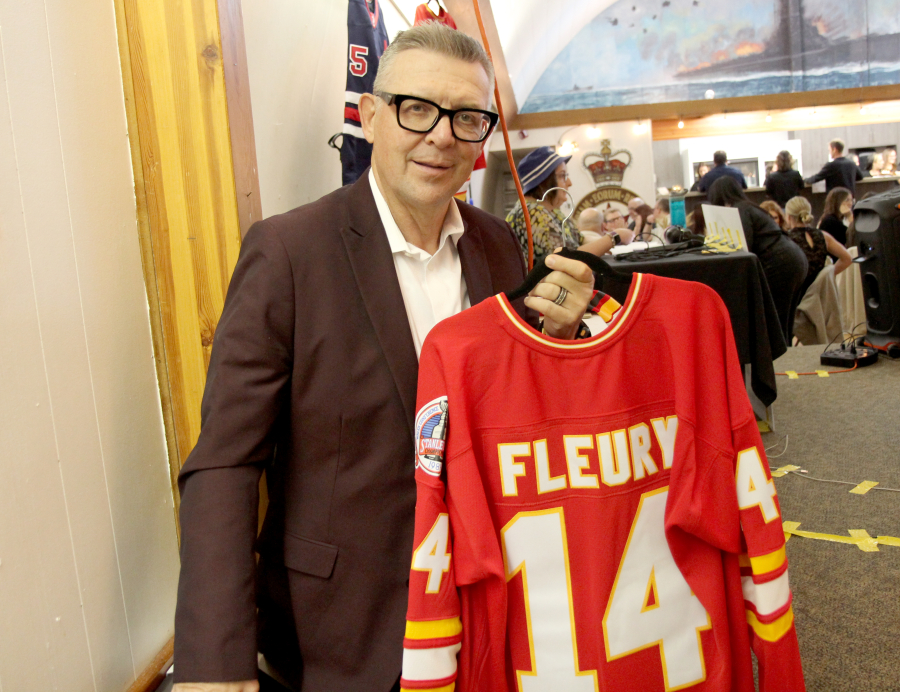
Fleury, best known for his years with the Calgary Flames, is a former Stanley Cup champion and Olympic gold medal winner. However, everything starts somewhere, and his story starts when his family moved to Binscarth. When asked if he wanted to play hockey, he said yes, grabbing whatever equipment they had – including Sears catalogues for pads – and headed to the rink. He fell in love with the game of hockey, a love he never lost. When the family moved to Russell, he found the best athletes in town were his age and with three great coaches, they began winning like crazy for nearly a decade. The coaches taught great life lessons. Respect, love and care for teammates and consequences for actions were all things he would remember forever.
“We became this amazing, this incredible little hockey team,” Fleury said.
He added we put our children in sports not to create professional athletes, but instead quality human beings. There are few NHL jobs, so a different focus must come from minor hockey. Polite, responsible, kind people should be the goal.
As for Fleury himself, he was picked in the eighth round by the Calgary Flames. However, he sits 64th in all time scoring. He began talking about making the NHL at a very young age, and in a sense, he was able to will himself into the league, through hard work. He trained himself to react, which is necessary in hockey as the game moves too fast to think.
At 14 years old, he was part of the first Bantam hockey draft, picked by the Winnipeg (now Moose Jaw) Warriors. At 15, he left for Winnipeg, and it would change his life as the coach and scout who found him would do the unthinkable. His name was Graham James, and he would sexually assault Fleury 150 times over two and half years.
“What I was left with was a lot of shame, a lot of guilt, a lot of anger, a lot of resentment,” he explained, “and there wasn’t one person I could have told in the world. I knew if I told, first and foremost I wouldn’t be believed, and second I knew it would be the end of my hockey career because I would be labeled as a liar, trouble-maker and all of those things. So I kept it a secret a very long time.”
Fleury added he soon discovered alcohol, which would help him cope. Although he became an instant alcoholic, he went on to a great hockey career. He captained the World Junior team, winning gold against a stacked Russian team. He signed with Calgary, winning the Turner Cup with Salt Lake City. Then came 1989, during his rookie year with the Flames. A Stanley Cup. He would later win the Canada Cup in 1991 and the gold medal in Salt Lake City in 2002.
Despite highs on the ice, life would not always be rosy, as James’ abuse and his way of coping caught up with him. In 2003, he was kicked out of the NHL due to his behavior. With the New York Rangers the season before, he had finished a massive contract.
“Can you imagine, a little poor guy from Russell, you drop him in New York and give him $30 million and tell him ‘behave yourself’? Not going to happen. I tried to take a bite out of the Big Apple and it took a very large bite out of me.”
He went to a treatment facility in Santa Fe, New Mexico and stayed there. He had a $3,500 a week cocaine habit, and left by himself. At one point, after being up for more than a week, he got a gun and bullets and put the barrel in his mouth. The life movie of good and bad ran through his mind. A little voice in his head said “you never quit anything in your life, why quit now?” He chose life, but really had no idea how to do it.
The rest of his story was of recovery and redemption. It was not without problems, as he would fall into the same habits. However, he found out he could pick his own divine being, one who could be as helpful and forgiving as he needed. Accepting this help was key, finding his prayers to not want drugs and alcoholic answered. That was September 18, 2005 and he has not had a drink or drug since.
“I just celebrated 20 years of sobriety last month. And what is cool about that is my dad who has 40 years of sobriety gave me my 20 year pin.”
He would write “Playing With Fire”. His plan was only to talk about his hockey career. However, his trust built with his co-writer, and everything came out. He told the whole story from start to finish and he was scared how the people and the media would react to the sexual abuse revelations. He wanted a story of hope, healing and recovery out to everyone. Fleury found that having the courage to tell his story would help others with the same trauma. In fact, as time went on, he began adopting the word “trauma” to explain all of these horrifying life experiences that impact life forever.
“When I switched from sexual abuse to trauma,” Fleury explained, “guess what happened? I invited all eight billion people on the planet into the conversation. We have a very serious mental health crisis on the planet and a very serious addiction crisis on the planet.”
We need to deal with the pain and trauma in our lives, without using addictive substances and behaviour. Fleury said we need to talk about our problems and heal from them. He found when he told his story, he was not judged and was not alone. The truth did set him free, as did the help of the one who he ultimately gave his life to. Fleury said none of the speeches were written by him, but by God, and that is why they have been so successful. He feels we all need that in our lives.
“My hope is that everyone gets some healing.”
Fleury would tell some stories of his hockey career, some familiar, some not so much. However, despite his exciting experiences on the ice, it would be his success at life despite his many challenges people would remember. He even got to the point where he could forgive Graham James, or as he said, he was able to forgive himself.
“It was complete freedom, and I was able to detach from that experience for the rest of my life.”
“Friendly Manitoba is the best place on the planet,” Fleury said at the end. “It is communities like yourself that raised a guy like me. You instilled me with morals and values that I used to make this amazing comeback in life. I hope you get this rink built, because it was truly my happy place.”
by PAUL RAYNER, Recorder staff