

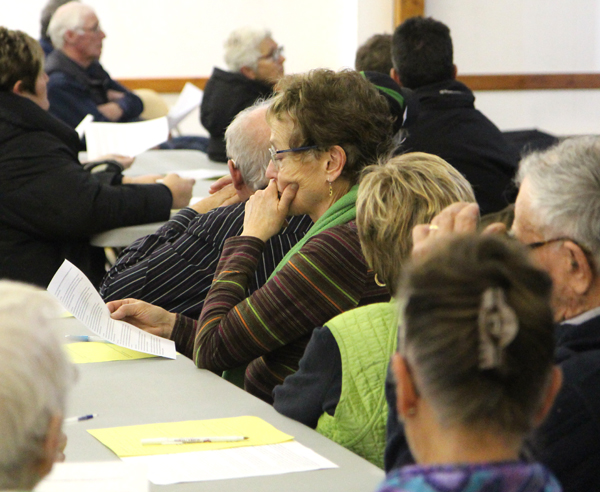
About 375 people crammed into the Legion Hall to hear a presentation from the Western Manitoba Health Care Task Force, and give comments on their ideas, on November 21. The group had already met with the public in other communities like Killarney and Deloraine, and Boissevain’s crowd was said to be the largest. Boissevain-Morton Councillor and task force member Judy Swanson commented on the local commitment.
“Thank you for caring enough to come out tonight,” Swanson said.
She explained how the task force came together after the 2016 AMM meeting, where they heard there were changes in the wind for health care. The feeling was it was better to be ahead of the curve and try to work out some ideas of their own for the future before someone simply imposed something. Nine municipalities from the Southwest area, including Boissevain-Morton, Killarney-Turtle Mountain, Deloraine-Winchester, Two Borders, Cartwright-Roblin, Melita, Prairie Lakes, Brenda-Waskada and Pipestone joined forces to create a task force, with two representatives each. Although Swanson said it was sometimes like “herding cats”, they not only met and discussed issues, but hired a consultant, Gord Daman of Niverville who had been working with Boissevain-Morton on a senior’s complex.
While this was going on, Boissevain and other communities had a bit of a crisis. Earlier this year, it was announced there would be a change to ambulance services, which would mean the closure of the garage in Boissevain. Swanson said while the task force met, a business case for Boissevain keeping its services was forwarded to government and she and now-Mayor David Stead joined forces with other communities in this dilemma. She announced that they would be meeting with Health Minister Kelvin Goertzen next week.
“We’re not giving up. That’s what we’re doing there.”
Daman started his presentation by congratulating Boissevain-Morton Council for being proactive and involved in a solution. He spoke of the task force, who it was and what its mandate was. Repeatedly through the evening he stressed a couple of points. One was the task force was not driven by the Province or the Prairie Mountain RHA, but instead by the nine municipalities. Also, although recommendations were made by the group about health care, nothing was written in stone. The community consultation meetings had in the previous nights, and would from Boissevain, provide insights into what the people themselves felt was important. The task force would respond to those opinions. As Swanson had stated, there could be changes to the wording, the report could be held, or it could be scrapped altogether. Daman added there would also be room for health care staff to participate in the process.
Daman discussed challenges in health care. Over the last 30-40 years, much has changed. For example, ambulance drivers were purely volunteers who took people to hospitals. Now they are fully-trained paramedics who provide front line care. Diagnostic equipment and how it is handled is much different, as is life expectancy. Demographics have changed too; as in about 30 years about 25% of the population will be seniors. After that, numbers will shift again.
Of course, health care has also become more expensive, with the department having rising costs and a need to cut their budget. Inflation has cut down the money coming in, but health care costs are rising at a higher rate. This has created a need to have another look at health care delivery. This is what the task force has done.
Daman said they came up with three themes of importance – emergency services, access to care and senior’s housing and long-term care. These would dominate discussion.
The first is the one on everyone’s lips right now, due to the government announcements. Daman said they are hoping they can get minds changed on this, but they had to plan for it to go forward. Valid concerns came up in discussion, such as the bad cell service in some areas, and the need for satellite phones in each ambulance. Also, they are looking for a commitment from the RHA to what is called “dynamic deployment”, using analytics. This would mean the ambulances would be deployed where the volume of calls is greatest. In the Niverville area, this meant they were deployed along a highway. It sounds funny, but it certainly improves response times. There is a need for the RHA to honestly collect and use the data.
Also, they are looking at establishing a First Responder service in some more remote areas, which would run under a community fire department. These people would be able to respond quickly to 911 calls and do basic care prior to the ambulance arriving. At any rate, Daman said they are calling on the Province to not shut any services until all of this is operational.
The second theme was access to care, which had the most interesting ideas and the ones that would most impact people. It would entail shifting our current health centres from acute care to urgent care. This does not mean a closure of anything, but as Daman said, it would be calling things by the right names.
“Right now, 80% of visits to the ER today are not emergencies,” he explained, “they are access to care issues, where they couldn’t get a doctor or there was no walk-in clinic. So 80% would see no difference.”
He added that others were urgent care issues, who would also see no difference. The remaining real emergencies, like a stroke, would be going by ambulance to a bigger centre anyway. In fact, they should not be going to small health centres, as often the EMT’s have more training in the area.
There are advantages to urgent care, which is a new definition that would include patients for short-term care usually prior to definite diagnosis. One of these would be the ability to have nurse practitioners, like Boissevain’s Sheryl Campbell, participate in on-call services, which they cannot do in an acute care system.

Eventually, they are looking at creating an access centre between Boissevain and Deloraine, two communities that already work together on on-call. The shared services would make everything more sustainable. All of the medical teams would be working together – doctors, nurses, nurse practitioners, mental health staff. As Boissevain’s health centre is newer, the initial plan is to locate it in Boissevain.
They are also looking down the road to create one big hospital for the region of about 30,000 people with around 60 beds and full diagnostics. It would be backed up by access centres and emergency services. Daman said facilities begin to age-out and with seven in the region, they may not be sustainable in the future. When and where this would be is up in the air.
“A lot of this will take time.”
An interesting aspect is the idea of having more nurse practitioners involved to do house calls. This would help take pressure off facilities, and help older people stay in their homes. Daman called it a sort of “back to the future” approach, which helps make health care more accessible as seniors do not have to go out for minor health care.
The third item of discussion was senior’s housing. There is a change in attitude, with more people living in their homes longer. They want to strengthen in-home supports for those who do this and develop assisted living options for those who need more support, but do not need a personal care home.
At the end of the evening, participants were asked to fill out questionnaires in groups to give opinions on proposals. These, and the ideas from other communities, would be compiled by the task force and given to the municipalities. The municipalities will vote whether or not to accept them, and if a majority passes the recommendations, they will be sent to the health minister.
Daman said they had received good feedback from the other communities and are committed to public consultation. Other areas have the same problems but have not dealt with them as quickly as our region, which gives us a leg up. The idea is to keep long term sustainability, keeping in mind that the system is not free.
Local member George Heide was happy with the major turnout, saying there was a lot of anxiety due to the ambulance concerns. He added there is no guarantee if the recommendations are made they will be accepted but they are happy with what they came up with and hope for the best.
“If we fail, we tried,” Heide said, “and that’s the most we can ask for.”
by PAUL RAYNER, Recorder staff