
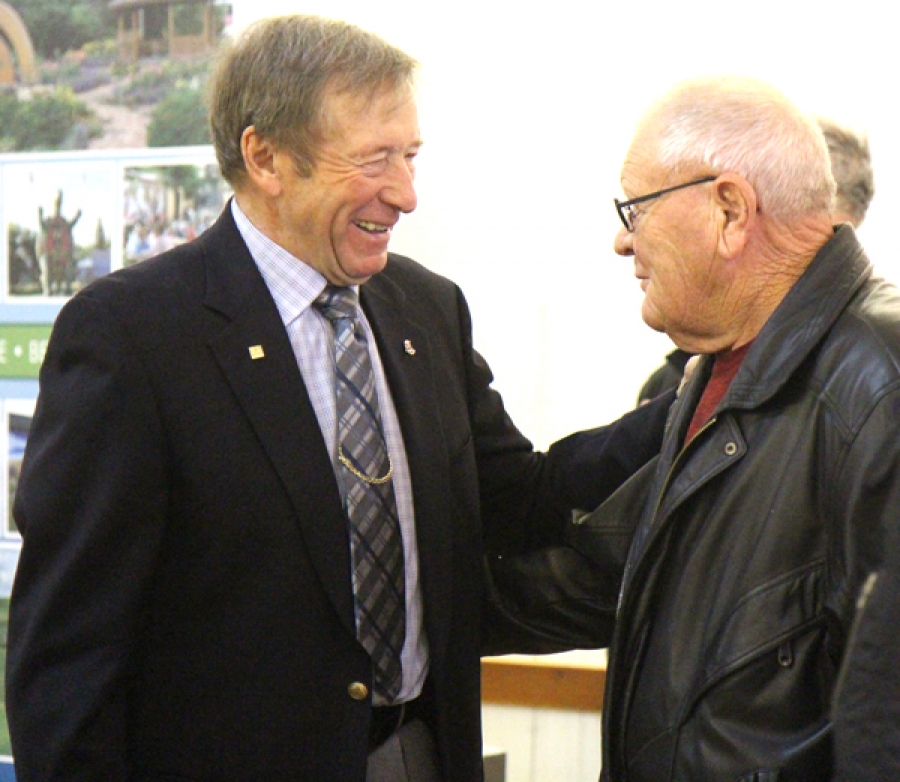
On November 6, Mayor Ed Anderson, who had occupied that position since 1989, officially stepped down. It was a day everyone knew would happen, although most in town hoped it would not. His reasoning for the move was simple.
“I have been on this council a long time,” Anderson stated. “I came in as a councillor, then moved on to mayor. I have really enjoyed this mayor thing; it has really been a nice experience. On the other hand, I am happy to move on to other things.”
Originally from MacGregor, he joined the RCAF to get his education in electrical engineering. From there, he started a 34-year career at MTS, where he eventually moved to Boissevain. After a few years, he ran for Boissevain Council. First elected in 1980, he was there for nine years under Mayor Jack Houston. Then he took over the mayor’s position and held it for nearly 30 years.
Over his tenure in office, a lot happened in the community. There were many capital projects like the vet clinic, water treatment plant, fifty lots in the new development, a new medical clinic, town shop/fire hall among others. He was instrumental in recruiting many health care professionals, including Dr. Meyer Nell and veterinarians Drs. Jeff Gervin and Haley Adams.

One of the big accomplishments for Anderson was Communities in Bloom. He was a big player in beautification in town, helping the community show its best face to the world. Many championships have been won, including some at the highest level. The mayor was very proud of this situation.
“Every year we seem to win at some level. It has really helped Boissevain get along. People are coming here from miles away. We have this beautiful main street, and people feel Boissevain is a major attraction in this part of the province.”
Others noticed. At the special National Award Ceremonies for Communities in Bloom held in September in Ottawa-Gatineau, Anderson, well known in CIB circles, was given five-blooms for Community Dedication. Fellow Councillor Judy Swanson said the organization wanted to honour some of the people who had contributed to the program at different levels and no one deserved the recognition more than Anderson.
Earlier in the year, he had foreshadowed his decision when he resigned from the board of the International Peace Garden. He had served there for 26 years, since 1994, and felt it was time to move on. He had been appointed by Premier Gary Filmon, and later served under Doer, Selinger and Pallister. He served a few terms as board president. During his time, the Game Warden Museum and a new Interpretive Centre were added to the area.
As for Council, he said he enjoyed his time and working with the other councillors. His last term involved the amalgamation of Boissevain and Morton into one entity, which he felt worked out well. He was hoping some new, younger people would take the reigns in Council, much like they have at the municipal office. He was staying on a few boards and had his livestock interests to keep him busy.
“I’ve got some pretty good cattle out there. I’m not going anywhere for sure. I’m here and you’re stuck with me.”
His replacement in the mayor’s chair was David Stead who himself is a Council veteran, mostly on the RM of Morton side. He started in 1992, and apart from a few years off, had been serving the community in that capacity since then. As well, in 2017, long time CAO Lloyd Leganchuk retired. He too was deeply involved in many projects in the community during his more than 23 years in the position, and was justifiably proud of them. Anderson himself gave Leganchuk a lot of credit for what they accomplished together. Leo Poulin stepped into the CAO’s shoes.
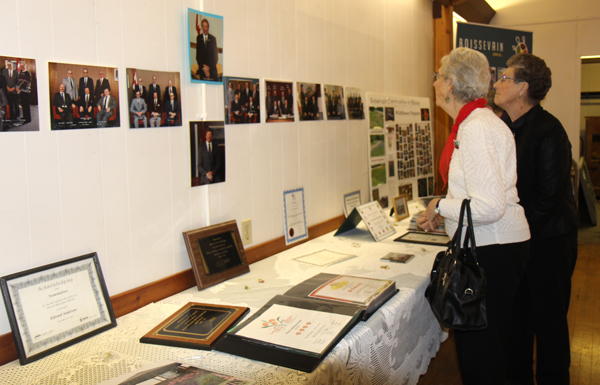
At the end, Anderson put his time and reasoning into a simple expression.
“I guess you feel you have a lot to offer,” the outgoing mayor said. “When you feel that way, I think you can do a good job, a fairly good job. And I feel I’ve done that.”
Ambulance cuts
Our community, and many others, received a shock this summer when the pronouncement was made there would be a change in EMS in rural communities. On July 29, Manitoba Health announced a major overhaul in its system, which would include shutting down 18 emergency ambulance stations. One of these was to be Boissevain.
Connie Debreuil of Manitoba Health said it came from a 2013 review of EMS. Historically, many ambulance stations were run by local municipalities, which meant they were not located on a strictly geographic basis. Some areas had difficulty keeping staff, and some 24/7 services.
“Everyone did amazing work,” she said. “Everybody put their heart and soul into it. But it was – how could we optimize the EMS across Manitoba if the slate was wiped down?”
Debreuil said they looked at call volumes and other factors. The idea would be to have some 24/7 stations placed in strategic areas, with the idea of having an ambulance at a place of need in 30 minutes, ninety percent of the time. Prairie Mountain Health CEO Penny Gilson said although there might not be a permanent station in Boissevain, she did not accept the idea the area on #10 highway south of Brandon would not have ambulance services.
“Highway #10 will not be left ‘uncovered’” Gilson said. “Stations in the area will have on site staff that will attend to any needs.”
The community itself was more than skeptical. Boissevain-Morton CAO Leo Poulin said Council was upset at the lack of consultation, and there were fears it might mean the beginning of the process of losing health care in the community. The municipality decided to fight the move, which would take several years to complete. They made a business case to take to the Province, which included the different times to respond to places in the area like Minto and Turtle Mountain Provincial Park. There were stats about the number of vehicles travelling through town, the ambulance call numbers, the various local attractions and the aging population. The well-made case showed how important it was to have the service in Boissevain.
An ominous incident proved the need for services on #10 south of Brandon. A rollover just north of the Peace Garden saw the driver receive serious injuries in October. A Good Samaritan named Stephanie Cruickshanks helped at the scene. Not able to use her cell phone to get service, she flagged down another driver and they went to Canada Customs to call an ambulance. It was a ten-minute delay, but the paramedics came from Boissevain as quickly as they could and treated the injured driver.
Cruickshanks pointed out how the scenario would be different if Boissevain lost its ambulance. If the driver had serious injuries, it could be life or death. She said people cannot let this happen.
“To the people of Manitoba,” she said, “This is not right. We can’t let rural Manitoba be given second or third rate service, it takes all of us to have a successful province.”
by PAUL RAYNER, Recorder staff