
“We started in 1996,” Forsyth explained, “so it’s been 22 years. The first few years we went every year, then backed off to every second year. I’d guess this is around #15.”
The genesis was from a group of Boissevain teachers taking a trip to Calgary to have a gander at a few progressive schools. From that trip came Connections. Forsyth was not part of that journey, but his first year in this school was the first Connections year, so he has been part of it from the start.
He explained the concept was one where the kids could create their own project, connect it to a couple of courses they were in, and show how education could link with the real world.
“The idea of Connections was to flip education 180 degrees. Normally, school projects are curriculum driven and teacher directed. Connections offers students a chance to demonstrate/display what it is they are passionate about and then bring that topic into the classroom. The kids are to find a ‘connection’ between their real life experiences and connect them to at least two high school courses.”
Forsyth said the grade 12 students at one time only had to connect to one class, as they were on the semester system. But now, like everyone else, they must connect to two. He added teachers have no input over the choices, which is the point.
Over the years, he said he has been impressed by a number of projects. There are no real favourites, but some stick out – converting a pedal bike to a motorized scooter, a houseboat renovation, musical projects.
“There have been so many good ones,” Forsyth said, “narrowing them down is impossible.”
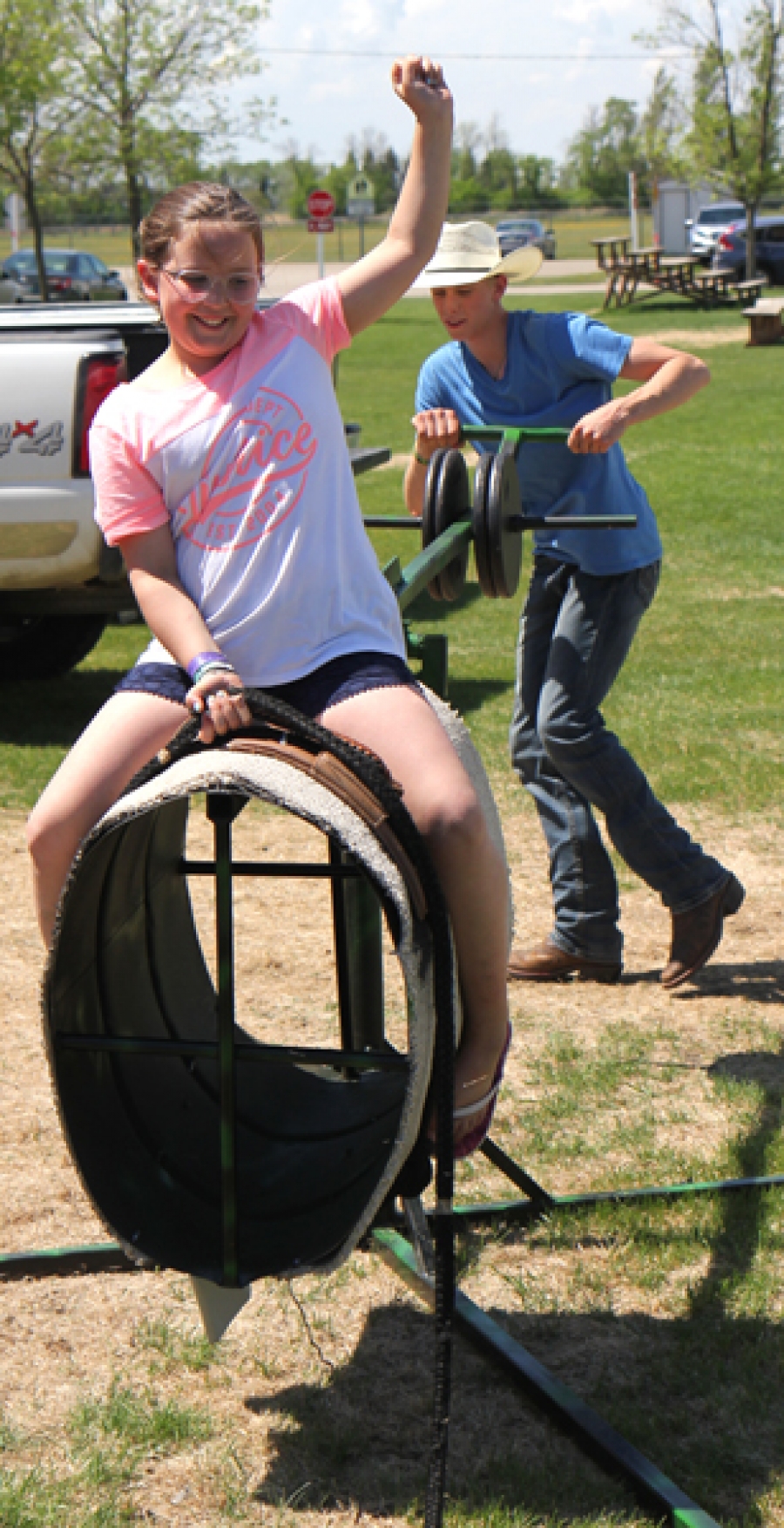
This year showed the same variety and skill. There were baking projects, astronomy, the construction of a hunting blind, several automotive. All of the students seemed very engaged with their projects.
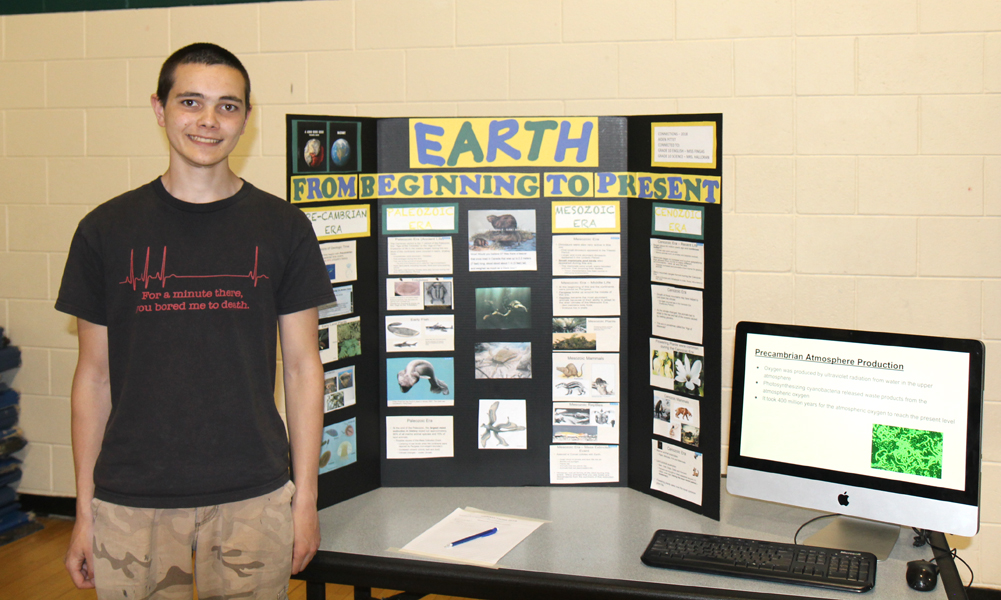
Aiden Pittet is in grade 10 and connected his undertaking to English/Language Arts and Science. This was his first Connections project, and was based on the four different eras the earth went through – Pre-Cambrian, Paleozoic, Mesozoic and Cenozoic. The science connection is fairly obvious as he was studying the beginning of the earth and the development of life on it. For English, there was a lot of writing, as much as eight pages – as well as a few on the science side. He also had a computer presentation, which showed the different eras in more detail, the rise of life from its very beginning, to the age of the reptiles, to our present period.
“I actually learned lots how life started, a better understanding of how it all started,” Pittet explained, “how dangerous everything was before it became stable.”

Kendalyn Penner too was in her first Connections Fair, in grade 9. Her project was “Solving for Pie”, main purpose being to find what it cost to bake different pies, including apple, blueberry and cherry. In order to do this, she did a lot of calculating and made a lot of pies – 65 pies in 18 hours. She chose it because she and her nana baked pies for a market in Souris.
“I’ve always loved baking,” Penner said, “and my nana has taught me how to make all these pies.”
The connection is to Home Ec and English. Again, Home Ec is obvious. With English she wrote about baking pies with her nana.
She learned there was a variation in pie costs, mostly because of fruit price differences. Most pies were in the $5 range to make, but she priced the Saskatoon pie at $14 because of the labour cost of picking the berries in Saskatchewan. She learned that there was a lot of work to the project.
“When people say it is as ‘easy as pie’ it is not actually as easy as pie.”
As well, she was planning to auction her pies on Thursday evening with the help of Kelly Wright. The money was to go to the Festival of the Arts. Penner is involved heavily in the Festival and she wanted to provide a scholarship for a student to continue with music studies.

Grade 10 student Shay Canada was outside with his GMC truck. Connecting with Essentials Math and Industrial Arts, he began the process of bringing the 1998 truck back to life. He cleaned up the black paint and made it silver, got the 4-wheel drive working, and got the chrome shining again. It was a project of opportunity.
“We had this old truck sitting in our yard there,” Canada explained. “I thought ‘well, might as well fix it up’ because we used to use it. Then I decided to do this. I think it turned out good.”
He added it still needed work to be roadworthy – it will be his vehicle when done. But Connections gave him the motivation to get going. He got experience with all of the tools, with help from his dad, and the budget helped connect it to math. He feels Connections is a good concept for students.
“This is my first time doing it, and I thought it would be something fun. And it gives the whole town a chance to see what our students can do. It was good to fix up an old vehicle that needed the work.”
Pittet agreed with that assessment.
“The part I love about Connections is the part where you can expand on your ideas,” Pittet explained. “You get to explain what you love to do, or something you want to do in the future.”
Penner thinks it is a very interesting idea for students to be involved in.
“I’ve enjoyed it a lot and I think it is a very good idea, because students get to pick what they do and get to do something they love. They can connect to anything, and pretty much do what they want,” she said.
Forsyth said despite the fact Connections is getting long in the tooth, the constant turnover of students keeps it fresh. It allows them to put their passions to work in self-directed projects that encourage them to be bold and creative. Will it continue in the future?
“I hope so,” Forsyth stated. “It is the one thing we do in our school that has a total community focus on academics and education and it has become an event both the school and the community looks forward to.”
by PAUL RAYNER, Recorder staff