
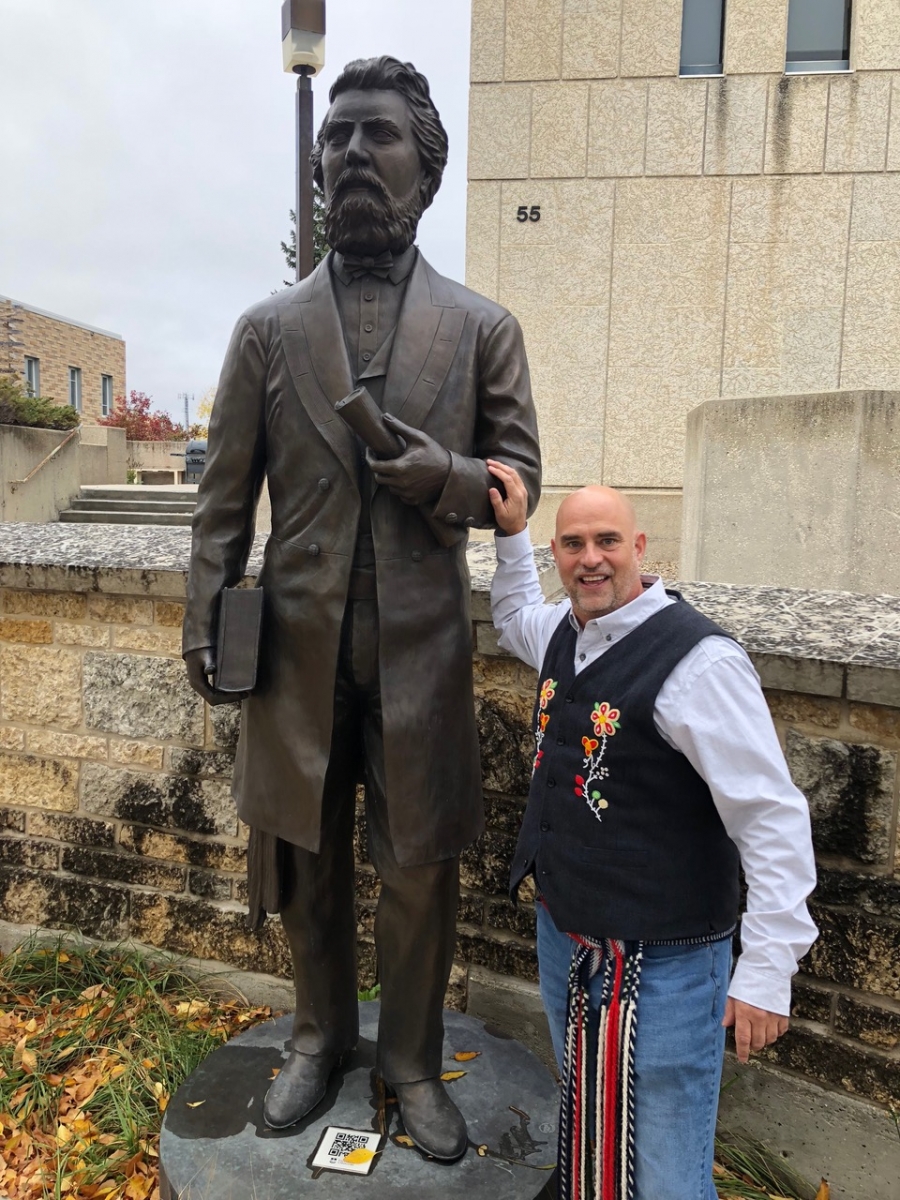
Goodon first ran as a representative for the Southwest Region many years ago and was unsuccessful. However, he won election in 2014 and was re-elected last year. He said in working with Chartrand he always felt the next step for him was to work for his people.
“I have always been proud of my heritage and this seemed to me to be a good way to serve.”
As he explained, the MMF is the government for the Metis people in Manitoba. They represent the Metis Nation people like a municipality represents its citizens. Like other governments, they are concerned with issues such as housing, health care, education and employment, but they are also concerned with securing constitutional rights for the Metis across the country, and they have had many successes on that front.
Goodon was re-appointed as Minister of Housing and Property Management by the president after the 2018 MMF elections. He said they are currently working on a big change in the housing department, as they were in the federal budget for the first time in 2017, finally recognized as the Metis Nation, and housing was the first priority. They will be focusing on seniors’ housing throughout the province for the first while.
Long before he was a minister, Goodon became recognized for standing up for Metis hunting rights. The MMF had issued harvester cards for its members, feeling this would be enough for them to exercise their rights to hunt in Manitoba. The government disagreed. Goodon was arrested for shooting a duck without a Provincial license in October 2004, and his case became a test case, going to provincial court until a ruling in January 2009 in his favour.
“R. v. Goodon was and still is a pivotal case for Metis rights and I was proud to play a small role by doing what I was always taught as a young person,” Goodon said. “It eventually led to the province-wide agreement that now sees Metis rights recognized throughout almost two-thirds of Manitoba.”
Recently, there was another issue that created a clash between the federal Metis Council and other Indigenous groups. Late last year, the council released a map encompassing Manitoba, Saskatchewan, Alberta, parts of Ontario, BC and the Northwest Territories. The idea was to identify the “Metis Homeland” – where their people come from and who they represent. There were concerns due to some people in eastern Canada self-identifying as Metis and using their symbols. The map was not new, but there was a feeling it needed to be released. However, other Aboriginal groups objected, feeling the Metis were laying claim to their own ancestral lands. Goodon said this is a misunderstanding.
“It is not a statement that it is an exclusive area of use for the Metis Nation, but an expression of shared territories. But most definitely, it is where we use and continue to use the land.”
Goodon feels his role continues to be to serve the people who elected him. They are the ones who deserve the respect that has never been theirs.
“The pride we see today has been hidden for generations,” he explained. “Our people can now be proud of their heritage as founders of Manitoba and partners in Confederation.”
One of those founders was Metis leader Louis Riel, who fought for his people and helped establish Manitoba. More than a decade ago, the February holiday was named after Riel. Goodon understands this significance.
“Louis Riel was and is one of our most famous leaders. He fought for the land and language rights of our people but also for the good of everyone who would call Manitoba home. To see this honour for our past leader is very positive. In the past, we were taught in school that he was a traitor. Today, Metis children can proudly say he was a true leader who fought for those that our country wanted to get rid of.”
by PAUL RAYNER, Recorder staff