
He said people being cruel to their brethren is not limited to our country by any means, and it is based in part on our nature, although our nature also contains beauty.
“As human beings, we are always fighting and the reason is we have free will, whereas an animal only has instinct, can only act on instinct. We act by free will so we can do the most terrible things. We can also do the most beautiful things. My father said we are the best and the worst.”
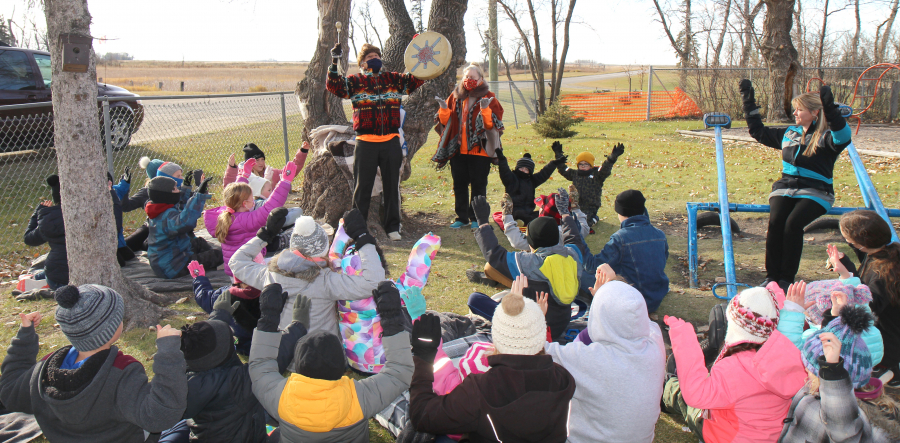
Wuttunee said he spoke to the students about nature, taught them a little Cree, particularly through songs. Near the close of the day, they went out together and prayed for a big tree in the schoolyard. Blessed tobacco was given to the tree, and they prayed for its success and the success of the school. Geri said the ceremony for the tree was significant. The couple had come to Minto School before, in 2015, and they spent the entire day outside under the tree, so its health has meaning to them.
Wuttunee originally comes from Saskatchewan. Early in his youth, he said his father brought them to town from the reserve so they could have an education. From that time, he said whenever they needed someone to speak, to give an address, they came to his family, as Wuttunees were always chiefs and knew how to speak publicly. He has been a singer and entertainer all of his life, and it seemed natural to him to go into schools.
“I have been in schools all over Canada, to Germany and Austria. The other day we were in Ukraine by Zoom for a couple of hours. I was just natural at it.”
Wuttunee said he would perform or speak wherever he is hired, at schools, universities, and retirement homes. Music is always involved, as this is where he has made his greatest mark since starting as a clarinetist in the Canadian Guards Regimental Band.
In the spring, the sad history of the residential schools was brought forward to Canadians once again in a most horrific way. We had known for years that these church-run government schools were awful places of cultural genocide and physical and sexual abuse. However, the story became even worse when it was revealed that schools had unmarked graves where the bodies of children were unceremoniously buried. This brought the issue of reconciling Indigenous and non-Indigenous Canadians back to the forefront.
Wuttunee said it was no surprise to their community.
“It impacted you more than it has us,” he explained. “We knew about it all the time, but you guys didn’t know about that.”
Justice Murray Sinclair said there would be many more graves found, as all of the schools buried remains this way. Wuttunee is glad Pope Francis will be dealing with this issue at long last, as the churches, like different levels of government, knew about the situation at the schools for a long time. Like the land taken for settlers, the schools are another example of Indigenous people getting a bad deal, and Wuttunee said it is time for a change. He added the non-Native population is ready for it more than ever, as they have been heavily impacted by the latest residential school revelations.
“They can’t believe that could actually happen to anyone, yet in their own countries that happened. In England, with their little kids, they couldn’t go to school. They had to go out and work. They had to bring the money home. The same thing in France, the same thing all over the world.”
Now, he tells the students about their experiences, in a good way. Wuttunee said he spoke about it with the kids from Minto for a short while, in a matter of fact way. Geri said it was important to do this with the students.
“That’s the truth part,” she said. “It is the truth part of the Truth and Reconciliation. If you don’t know what the truth is, you don’t know that you’re reconciling. You have to understand, and once you understand you can reconcile.”
His dream now is to start an Indigenous school for Native education. Wuttunee said it would allow students to learn about the songs and dances of the people. This is the education that was here for generations before the modern period, and could get lost if there is not more focus on it. As an example, he said as they no longer hunt the buffalo, many do not know the traditional buffalo dance.
“There are all kinds of dances. If you talk about classical music, we are the true classical musicians of North America. Mozart and those guys belong to Europe. We are the true classical musicians of North America,” he stated.
He said Canada has a beautiful education system now, but there needs to be more time spent on Aboriginal cultures, music and language. Wuttunee wants to create a program to connect all of these together, and prepare it for universities. He said the sooner it is done the better, as they are losing their older people, although many young ones are getting to know the songs and dances.
There are more presentations on the horizon. Some are on Zoom, but they are starting to get out on the road again post-COVID. If all goes well, they will be returning to Minto School in the New Year.
As for coming into the schools, Wuttunee talks of allies, both Indigenous and non-Indigenous. As Geri said, you start with the young people, and as they understand the story, they are the ones to make the changes. He has been impressed with how much they care and have been able to absorb.
“I know I am just all surprised by they way they think and the things they understand already.”
“When we go to different schools and work with non-Native people, we have to remember you are allies not enemies,” Wuttunee continued. “We have to treat you like allies, have fun together. It’s very important to remember that. We all have something beautiful.”
by PAUL RAYNER, Recorder staff