
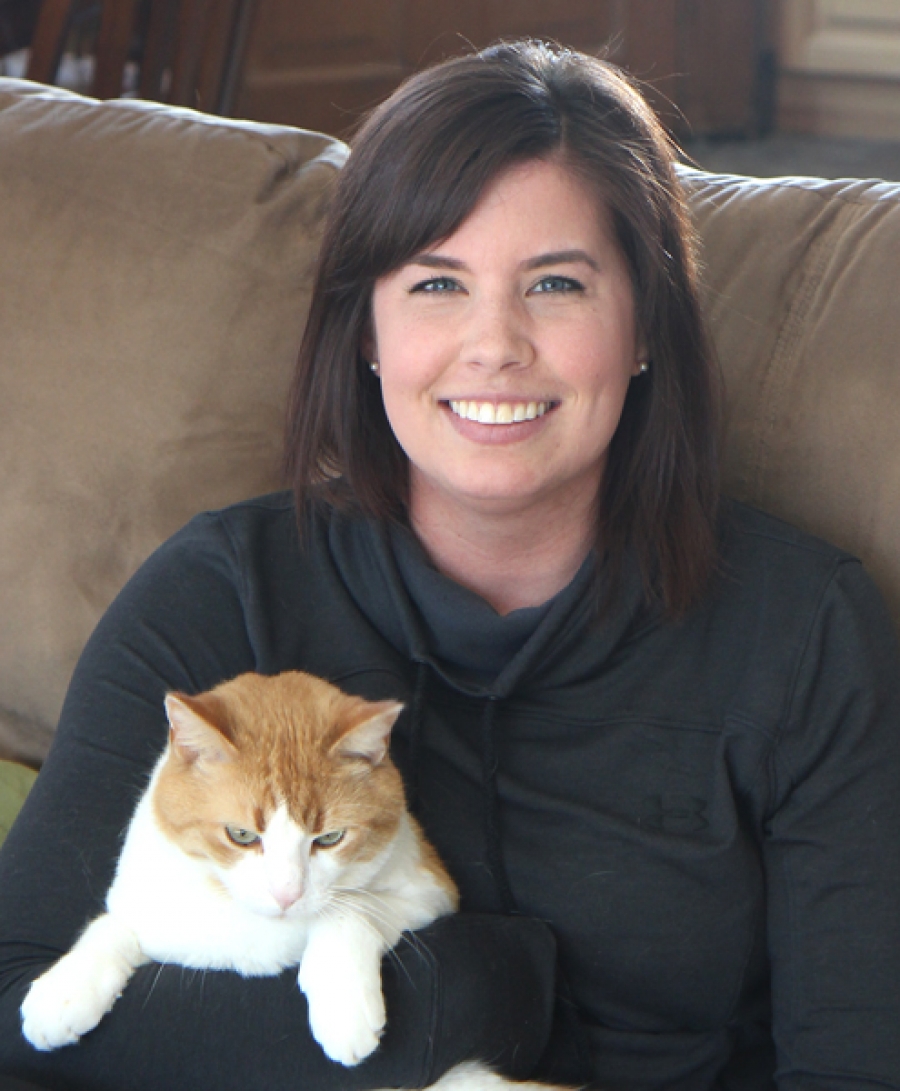
The Boissevain resident and wife of Nevin Stobbe is recovering from her second kidney transplant. Recently home after her February 16 operation, she is seeing light at the end of a long tunnel.
“I’m feeling really good,” Stobbe said this past week. “The operation was a month ago on Thursday. I was pretty stiff for a while, but I’m not as stiff anymore. It has been a bad year and everything is finally going right.”
Stobbe’s story started a decade ago when she was in university. She started falling asleep in class and had no energy. Doctors were mystified about the cause until one of them ordered the right tests. What they found was not encouraging.
They discovered that Stobbe suffered from IgA nephropathy, a kidney disease also known as Berger’s, in which proteins get into the kidneys and hamper their ability to do their filtering work. Eventually, it will destroy the kidneys. In Stobbe’s case, it affected both, with their function at 50% and dropping.
She went on dialysis for eight months, not doing well in the process, saying her blood pressure was high and she was feeling sick. By 2010, doctors found her mother was a good match and she donated a kidney to Stobbe.
“I was 22 at the time. I was really excited to get it and once I was done I felt 1000% better. I felt immediately better after the first transplant.”
However, it did not last. The disease returned. Doctors had said it was not likely to happen, but after a biopsy, they found the scarring again. She said eventually it was down to 60% function and continued to fail until it was down to 10% in December 2015. After five years, Stobbe was back on dialysis.
“It was very disheartening,” she said. “It was really too bad, because I felt good at first. It seemed so soon after.”
She initially started on home dialysis with a unit that operated every day. But then she ended up getting an infection and had to go to Brandon three times a week for three and a half hours a day.
Testing family members for another transplant began. Her father was incompatible, but her three siblings matched. Her younger brother Andrew was the best of the lot, and although he was living in Seattle at the time, had no hesitation coming home to be tested and to give the ultimate gift.
“He was really excited. He came up to do the testing, and was able to get some time off.”
She added there were a lot of people wanting to get tested and help her out with a donation.
“I was really lucky to have that kind of support.”
She went to the Health Sciences Centre in Winnipeg the night before to do a dialysis prior to the surgery. She admitted to being more scared the second time, in part because she had been on blood thinners prior to the operation.
At first everything went well. Her brother went in earlier in the day and had his kidney taken out. When her mother donated, it was a bigger surgery, but by the time Andrew did it they were able to pull it out from a small hole in the belly button, a procedure he enjoyed watching on video after. Stobbe was brought in, the kidney was put in and hooked up and she went to the recovery room.
But the night of the surgery, her blood pressure dropped and her heart rate went up. She had to have two units of blood. She was frightened and they brought her husband Nevin in to stay with her overnight. Stobbe needed another couple of units over the following weekend and everything eventually stabilized.
“It was my worst nightmare come true,” Stobbe explained, “but it was the best possible scenario after. They figured it was a weeping bleed and it did not affect the kidney.”
She was in the hospital for ten days, then had to stay in the city for blood work after. Now she has to do two blood tests a week, one in Boissevain and one in Winnipeg. She has to take immunosuppressive drugs for the rest of her life, although the dosages might change, to help accept the organ. One impact of that is she can get sick easier and have more trouble kicking something. It means being careful. For the first while, she had to wear a mask when she went out. Now she can go out and see people.
Stobbe is slowly improving, as happens after major surgeries. She realizes she is very lucky to not only have a donation once, but twice.
“When I was on dialysis, I would see all of the other people there. Quite a few passed away. It is hard on the body, hard on the heart. It was tough to see that.”
On Monday evening, March 20, Transplant Manitoba Gift of Life representatives came to Boissevain to discuss organ donation and promote people signing up to be an organ donor online.
Wanda Cameron came up with the idea of the organ donor information night after listening to a CBC program that said Manitoba had one of the lowest numbers of people signing organ donor cards. Several stories on the news have come up about family members having to make decisions about this after a person passes, so she felt it would be worthwhile to hold an information evening. The Palliative Care committee agreed to help and it was on.
There was a second presentation made to students in Grades 7 - 12 at Boissevain School on Tuesday. Roberta Koscielny, Communications Specialist with Transplant Manitoba, spoke about how to become an organ donor and the importance of it. Heart transplant recipient Barb Kolomi also spoke about her personal experience.
Stobbe said this type of awareness is very important. She said getting a donation like a kidney or liver from a living donor makes it last much longer. At any rate, it is important for people to sign up online and see how crucial it can be. Doing so is simple, all that is required is a Manitoba Health Card and a few minutes to fill out a questionnaire.
“I had to depend on someone for something like this. You are saving someone’s life. When it was me, so many people wanted to be tested, it was overwhelming. More people are getting to know people with transplants, and I think that helps show people how important it is.”
Jessica Stobbe had her second kidney transplant on February 16, 2017 at the Health Sciences Centre in Winnipeg. Jess is now recovering at her home 6 miles southeast of Boissevain. Photo by Anna Latimer
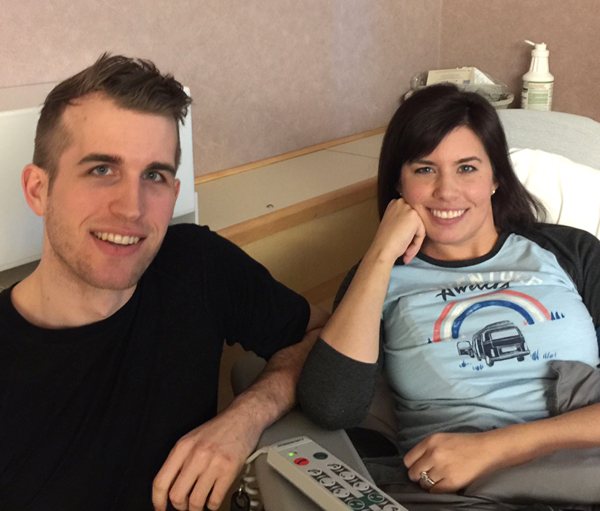
Kidney donor Andrew Helwer visits his sister Jess Stobbe in the hospital while she receives a dialysis treatment. Jess travelled to Brandon three times a week to be hooked up to a machine, that did the job of her kidneys, for three and a half hours, before receiving a kidney from her brother in February.
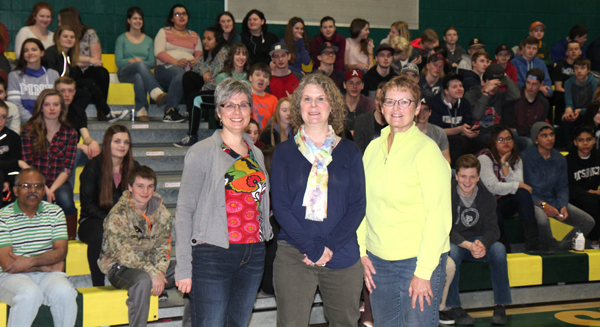
Transplant Manitoba Gift of Life held a public information evening on Monday, March 20 at the Boissevain United Church CE Building. On Tuesday, March 21 they visited Boissevain School and gave a presentation to the students. Roberta Koscielny (left) spoke about how to become an organ donor and the importance of doing so. Barb Kolomi (middle) spoke about her experience before and after receiving her heart transplant in 2016. Wanda Cameron (right) and Boissevain Palliative Care organized the presentations in Boissevain. If you would like to become an organ donor visit signupforlife.ca.
photo by anna latimer
PHOTO COURTESY OF JESS STOBBE
by PAUL RAYNER, Recorder staff