
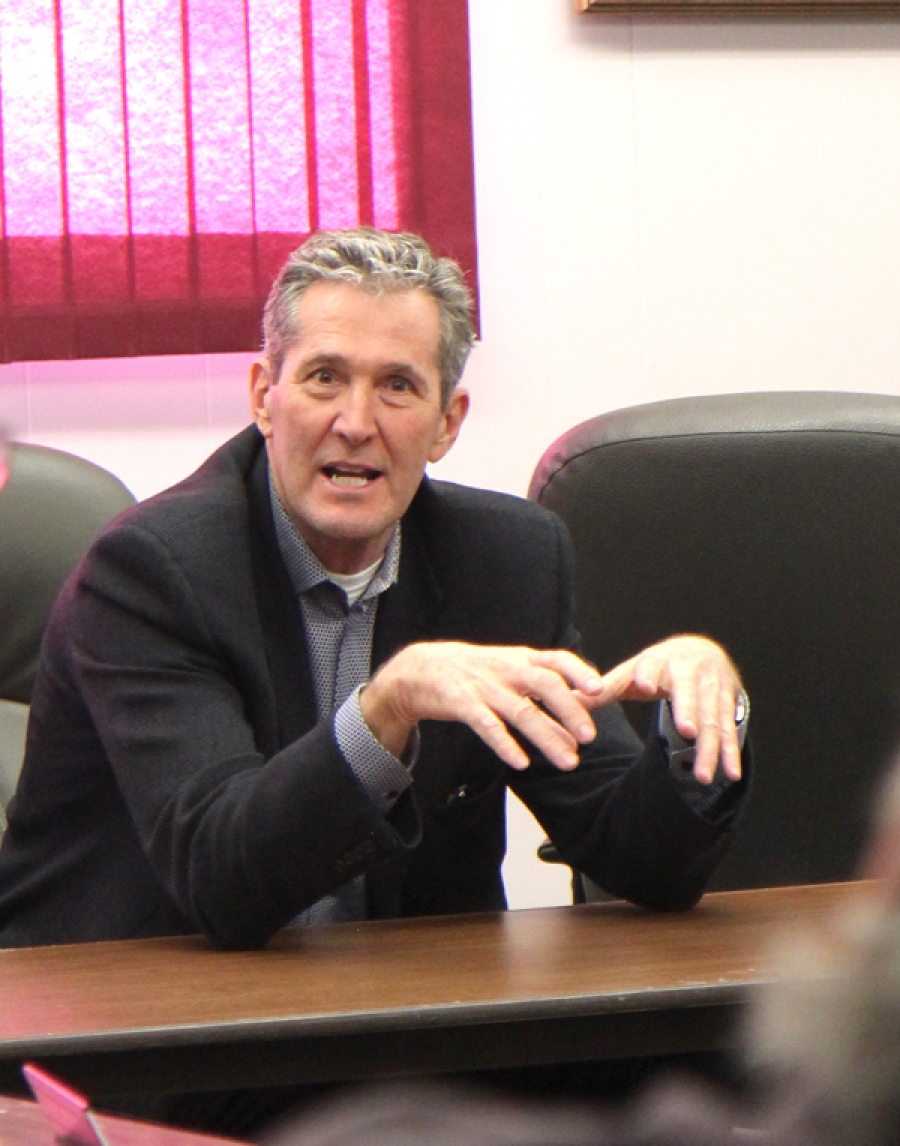
The Manitoba leader was in Boissevain with MLA’s Cliff Cullen and Doyle Piwniuk to talk to local municipal council members on Friday, March 24. There were a few different agenda items, but being that it is spring, talk did move to flooding.
Manitoba has certainly seen its share of precipitation this winter, and so there are concerns a sudden turn of snow to water could cause some serious problems across various areas of the province. Pallister said they are getting regular flood reports and are talking to different municipalities about their situations. His hope is that recent developments will take some pressure off the dangerous situation.
“There has been some early melt, and that is good news.” Pallister stated. “We’re hoping for the same treatment – freeze, melt, freeze, melt – with no precipitation.”
No flood related discussion in this area could possibly last very long without the topic of Whitewater Lake coming up. Farmers and municipal leaders in Boissevain-Morton and Deloraine-Winchester have been struggling with the swelling waters of the shallow lake for nearly a decade, as it expands its banks and swallows up farmland. A committee made of the two municipalities came up with the idea of developing a channel at Medora Creek and the lake, which would allow them to move some of the water into the Souris River and hopefully stop the immediate problems and reclaim some of the lost farmland.
Local leaders involved in the possible channel project discussed its minutiae in detail with the premier. Their commitment to not drain the lake, but only bring it down to its natural level was brought up, as well as their idea of only moving the water at non-peak times. As for this year, Pallister asked how the snow was in the Turtle Mountains. The answer was predictable – very bad and it will drain into the big lake when it melts.

There was frustration shown at the slow progress those working on the project have made with the preceding NDP government. The patience with the Conservatives also seemed thin. Pallister responded.
“I am familiar with your plan and I am very sorry the previous government did not keep its promises to you.”
However, Pallister let it be known to those in attendance that the Provincial coffers were fairly bare. His predecessors, he said, left Manitoba in a tough position financially. For example, the former teacher and union rep said before the NDP left power, they signed some pretty lucrative contracts with unions. This hampers his efforts now.
“How can you run a business when you are handed a big bill for your payroll, you’re spending $3 million a day more than you are bringing in, which is where we are at right now. I like a challenge but…”
Pallister said they had to get their fiscal house in order or they would be leaving the children and grandchildren in a bigger mess. He also said he was not willing to raise taxes. This means only cuts and belt tightening. The premier expressed frustration with some high-level government workers, saying he went to all of the deputy ministers for ideas on how to cut spending. Nothing of value came from it.

Still, for people on the ground in the area, this does not hold back the waters of Whitewater Lake or pay for rebuilding damaged roads. Again, the premier showed sympathy, but told people they had to be patient. If it was any consolation, he said, they were finally getting started on a drainage issue at Lake Manitoba that had been festering for decades. Perhaps that shows some intent?
“I hope that gives you a little hope, shows my sincerity,” the premier said. “I know this situation, it frustrates me too. But I’m not here to be Santa Claus; I’m not going to buy your vote. I’m not that kind of man. I will do the best for you that I can.”
Pallister also discussed the federal carbon tax, saying Trudeau’s government was proposing a disastrous concept for Manitoba, who he said was the greenest province in the country. He wants input to help develop our own environmental plan to suit our own needs.
“If we don’t do our own plan, we will be stuck with their plan.”
Pallister said he did not care about “takeoffs” but instead “landings” – projects completed not contemplated. He praised municipal governments, saying he looked forward to working with them more in the future.
“Municipal governments are the best people to deal with local issues,” he said. “They are the closest to the ground.”
by PAUL RAYNER, Recorder staff