
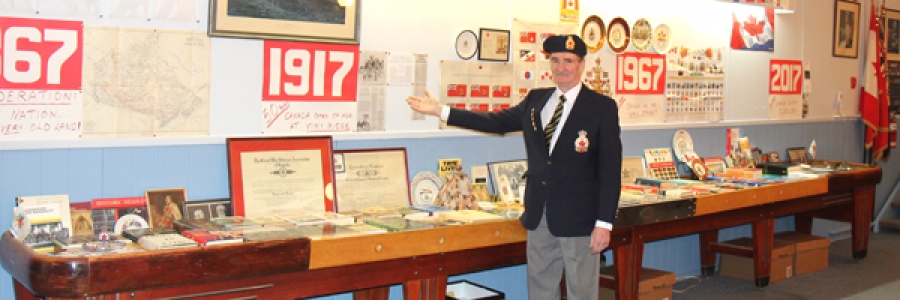
Legion President Doug McCallum has created a special display in the clubroom to celebrate the nation’s special anniversary. Featuring books, articles and artifacts from his personal collection, the display presents memories of 150 years, with emphasis on how the history so neatly breaks down into 50 year intervals and how he hopes we can continue to evolve into the future.
McCallum said the beginning of the project coincides with the beginning of his presidency about four years ago. A member of the larger Legion since 1974 when sons and daughters were invited to replace aging veterans, upon taking on the presidency here he began making moves to improve their profile. This included taking part in the July 1 parade.
“My motivation is to promote the Legion,” McCallum said. “The word of our demise has been greatly exaggerated. We’re still here.”
“I’m also a proud Canadian and a student of history. I wasn’t around at Vimy, but in 1967 I was involved in trying to rally the troops for Centennial projects.”
In fact, McCallum, who had won a trip to New York, visited the Expo World Fair in Montreal that year. Upon returning home to Creelman, Saskatchewan, he convinced the school to make a trip to return in the fall. The year 1967 is one of the 50-year highlight points in his display, showing how Canada was beginning to present itself on the world stage during its 100th birthday.
His display begins at Confederation in 1867, the beginning of the nation as a whole. He titles it “a new nation in a very old land”, something that will come up later. It shows the British tradition, the Hudson Bay Company impact. Over the years, it highlights other developments like the Statute of Westminster in 1931, the development of Canadian citizenship in 1947, the new flag in 1964. There is the Depression, the development of Medicare and it moves to the present day of 2017.
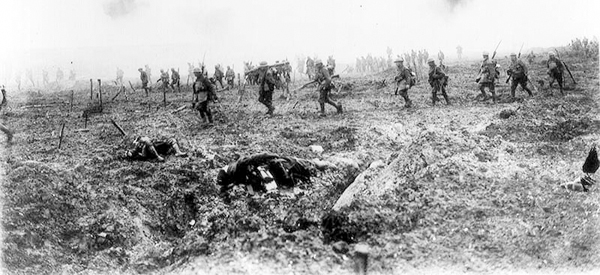
But 1917, the first fifty years of Canada, is a big focus as it is 100 years ago. It is there that many say Canada was truly born on a battlefield in France known as Vimy Ridge. This weekend, April 9 will be the 100th anniversary of the country’s pivotal battle and a major focus for the Legion.
McCallum has been doing these displays since 2014 as part of marking the 100 years of the First World War. Each year, he updates them to include the specific year, and though it has a larger focus this year due to the 150th, the connection is still major.
“It is a very significant part of the story from the Legion point of view,” he explained. “I emphasize we are not celebrating Vimy Ridge, we are honouring and remembering it.”
By 1917, the Western Front had long since degenerated into an entrenched killing field. All of the Allied Powers were suffering. France had won a pyrrhic victory at Verdun, and would soon struggle with mutinies. The British Army had suffered pointless casualties in the Somme. The Italians had their Caporetto disaster on the horizon, and soon Russia would be thrown into revolution. The previous year had not been kind and there was little saying 1917 would be better.
But the French had the Nivelle Offensive planned, and the British would fight a diversionary attack in Arras. As part of this, the Canadian Corps, fighting as a full entity for the first time was to take Vimy Ridge, high ground on the northern end. Previous to the attack, Canadian troops were extensively trained on particulars, with models of the German trench lines. A great deal of attention was given to specialized sections of machine guns, grenadiers and riflemen as well as underground tunneling. As well, lessons of the past leaned toward creeping artillery barrages that would cover the troops as they moved across ‘No Man’s Land’.
On April 9, Easter Monday, with rain and snow pelting them, the Canadians left their trenches. By the end of the first day, they had captured most of the ridge, an amazing achievement at the time. By April 12, the operation was over, with the Germans losing the village of Givenchy-en-Gohhelle and moving their defensive line.
It was not a battle without cost, however. Around 10,000 Canadians became casualties with 3,598 dying. Due to this success, and the cost, many felt Canada was truly born on Vimy, and it is there our national memorial lies. If nothing else, it provided something positive to the Allies during a difficult period. Coincidentally, it almost neatly dovetailed with the entry of the United States in the war.
“For all of the attention it gets, it only lasted a few days. We like to emphasize the fact that every other country tried and failed to take it.”
McCallum said Vimy is very significant, and is definitely so for this area as many veterans were involved. One of the big displays in the clubroom is the wooden cross, the original grave marker for William Remnant of Elgin, who at 19, was killed on April 10 at Vimy. It was given to their care in 1978 and has been there ever since. They have been able to put together some of Remnant’s letters home from France, including one on April 4, a few days before his death.
“This always gets people’s attention. They were not just nameless soldiers.”
Also part of the memorial will be Legion members attending the Anglican and United Churches this Sunday, something they have not always done. It is a way to mark the actual date of the battle.
McCallum hopes plenty come to visit the display this year, including those touring the community, and maybe some will be inspired to swell the Legion ranks. He hopes to remind people that the country we have did come with a very human cost and it was not cheap. It is not only at Vimy, however. As he says in the beginning of his display, Canada was built on an old land. In the early part, he has a book on Louis Riel. He feels we have to remember the people who were in this country before we came, and work on reconciling with the Aboriginal peoples. McCallum said the Legion strives to not forget and to carry forward. Perhaps we must all be part of that.
“Part of our obligation is to prove worthy of all the sacrifices,” he said, “to make a country worthy of all of that.”
by PAUL RAYNER, Recorder staff