
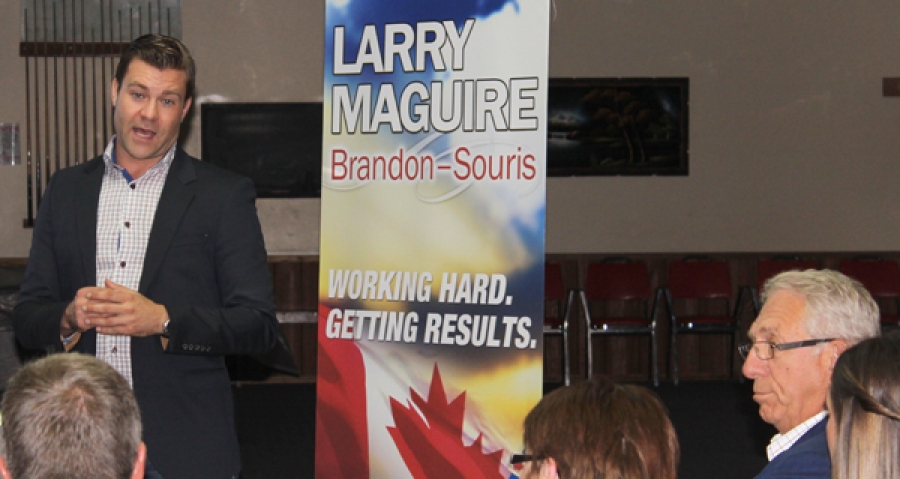
Larry Maguire, MP for Brandon Souris, hosted a round table in Deloraine on Tuesday, August 22 to discuss Bills C-45 (Cannabis Act to provide legal access to cannabis and to control and regulate its production, distribution and sale) and C-46 (an act to amend the Criminal Code - offences relating to conveyances).
“I went through the bills myself and we looked at it and I just felt there was a lot of unanswered questions,” stated Maguire.
This was the start of the two-hour town hall discussion and information session presented by Drew Ostash, member assistant for Maguire.
The discussion was not to condemn or promote marijuana but rather to evaluate what may be missing from the proposed bills. The Premiers, when at the Council of Federation, made a statement that they are concerned.
“They know that the enforcement and the regulation and actual transaction of purchasing and licensing and distribution will fall on the provinces so they don’t know what it is going to cost. They’re worried about July 1, 2018,” stated Ostash.
“Very few provinces and I don’t know any municipalities who have gotten to that point to get ready for that date. They’re concerned about road safety; don’t know what taxes are going to be. We don’t know what the education campaign is going to be and we actually don’t have enough marijuana being grown legally through our licensed producers to be ready for the July 1 date.”
There is no way provinces can really get out of accepting this legislation as the bill states the federal government will allow mail orders if a province doesn’t have a legal distribution system in place. Is it better to support your province and hope that if they do tax marijuana and maybe amend the bill so that some of that money comes back to the province like the gas tax or use it to help pay off the deficit as suggested by community members at the meeting. There are hopes that with this legislation coming about, that black market drugs will be decreased as it did in Colorado, for example.
With many different perspectives at the meeting some very good questions were brought forward. Those who are on medicinal marijuana can legally carry/possess 90 grams; the bill proposes that 30 grams can be legally possessed or consumed. This amount is equivalent to approximately 90-120 joints.
A gentleman who is a medicinal user explained at the meeting that he has to treat his marijuana as if it were a gun. It is to be in a locked safe.
At the moment, where or how it is to be kept will be up to those who choose to purchase or grow their own after July 1, 2018. It was suggested that it be treated the same way you would treat liquor in your home, so that children cannot have access to it.
Currently the age of 18 would be the legal age to possess or consume in Manitoba. This age was chosen, as it is also the legal drinking age in our province. However, the Canadian Medical Association disagrees with this choice. They have found that until the age of 25 your brain hasn’t fully developed and advise the minimum age be 21 years. The CMA would also like to see potency and quantities of marijuana be reduced in amounts to anyone under the age of 21.
Marijuana can have benefits for many people of varying ages. Some common medical ailments for using marijuana are PTSD, cancer, multiple sclerosis and glaucoma. This can be an alternative to opioids and other prescribed drugs.
A community member using medicinal marijuana at the discussions was educating other members that it’s not just a joint to be smoked, you can take it by drops, pills, or even use it to make butter for baking. What you apparently do have to watch for is the THC (tetrahydrocannabinol) levels as they can vary. These levels of THC can vary and nowhere does it state in Bill C-45 how this will be regulated. It has been suggested at these town hall meetings that maybe marijuana should be packaged like cigarettes but branded like alcohol with the potency (THC) levels?
The penalties outlined seem to be one area that didn’t pose many objections. How is the testing of marijuana going to be regulated? There is a “roadside oral fluid device” that tests the saliva in your mouth for THC levels.
However, THC levels can be found in some samples even after 2 weeks since being used. Of course this will vary for each individual and depending on the potency of the marijuana being used. If THC of a certain level are found the RCMP would then have the right to collect a blood sample. For those of us living in rural Manitoba, without full time labs in our hospitals, how would this be conducted?
Another concern put forth from community members were the small numbers of RCMP we have in our rural communities already. How are they going to be able to send our already shared staff amongst communities away to be trained? Mothers Against Drunk Driving say the cost to train an officer to be able to perform drug recognition testing is around $26,000. Who is footing the bill for this and will we have enough time and funds to get officers properly trained and equipped with accurate devices?
These and many other items on both bills were discussed and the information being gathered is to help figure out a roadmap as to what to do next with the hope of pushing back the timeline to get the blanks filled in.
“The Government has a bill, they have a mandate, they have the opportunity to put this through and as far as I know right now unless there is a huge human cry in Canada they will put it through this fall,” said Maguire.
“Whether you are pro marijuana licensing or against it, one thing that seems to be a consensus is that we need to have more time,” he added. “You need to be able to put more parameters around what the regulations will be and let the public know what they will be so that they can actually make a more sound decision.”
As one of the community members at the meeting suggested, we are back to a town hall meeting similar to one that would have been held 80-90 years ago discussing prohibition and the legalization of alcohol. Whenever changes take place there is always a learning curve but it is what you do to prepare for it that either makes it a success or a failure.
by ANG ANDRIES, Recorder Correspondent