
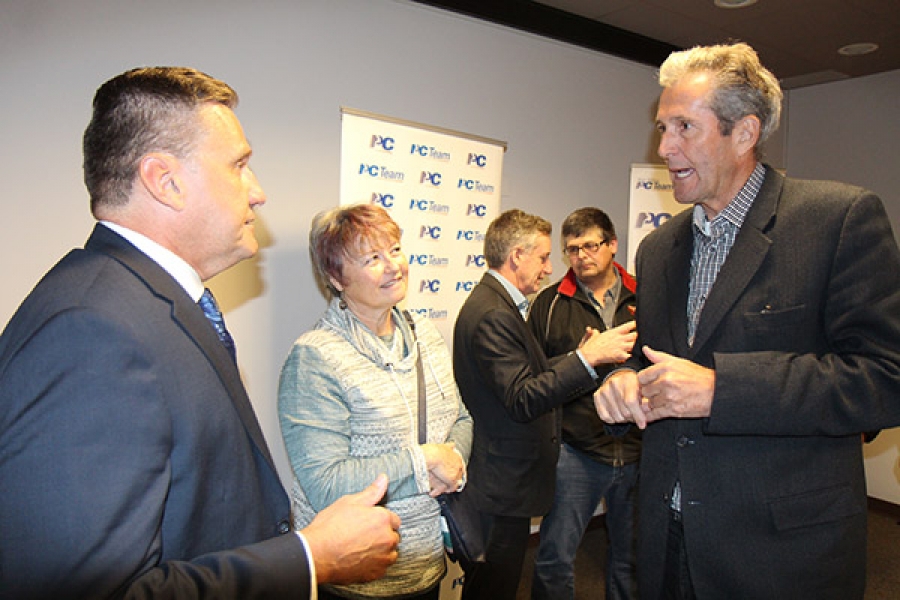
“It is never too early in the case where the boundaries are changing and there are new communities to represent,” Pallister explained, “Doyle has done a tremendous job for the people since he came in during a by-election several years ago, but he needs to get to know the people and the people need to get to know him. And of course, with the boundaries changing he’s going to be representing some new communities, so this gives him a chance to get out there, to be known, and to know the issues around the riding. He knows many of them, obviously, but each area is different, and each area has its priorities, so this is a good opportunity to get our candidate ready.”
The process did not come without some controversy. There were complaints from the mayor of Killarney-Turtle Mountain, Rick Pauls, who wanted to run for the candidate slot, that he was not given a chance due to timing and membership concerns, and the desire to have Piwniuk in the role. The premier rejected these concerns.
“I would say the mayor is wrong and he’s been wrong in the past on issues like this and he’s wrong again. I would say organized political parties get their people in place early and that’s what we’re doing. As far as the process itself, the process is well understood and the party has established a process that’s fair, the rules the members of the party agreed to in our constitution are being followed. That’s what you want a party to do, to follow the rules, and we’re doing that.”
He added there is likely to be some heavily contested nominations in other ridings. There have to be founding meetings in each of the 57 as the boundaries have changed. They are about five done, and by the end of February they hope to have around 25 or more founded, then continue on. It helps them build up their grassroots support and get an idea what the issues facing the electorate are.
With Piwniuk living in Virden, he would not be a resident of Turtle Mountain. Pallister said this was not a concern. It is fairly common, and he said the main issue is whether or not the person has a good understanding of what is going on in the area and his or her work ethic. Pallister said Piwniuk has done a great job getting to know the people and being accessible to the public.
Locally, Piwniuk is now on the International Peace Garden Board, which will help keep him connected to the Boissevain area. The MLA himself said he looks forward to the chance to continue to represent this area, and new ground as well.
“We have connections here in Boissevain,” Piwniuk said. “Many years ago my wife Michelle was the Rec Director here for two years. It is very dear to us, and the Turtle Mountains are one of the most beautiful places in Manitoba. You are there to represent the people and to make sure their voices are heard in Winnipeg.”
He said this is an opportunity to meet some new people outside of his old constituency.
Rumours have been around that Pallister would call an early election this time around. Not surprisingly, he would not commit one-way or the other.
“You know I’m a sports guy,” the premier said, “and it would be foolhardy of me to tell the NDP and the Liberals when the election is. I’m not going to do that. But what I will say, is we will do it at a time that will best benefit Manitobans.”
Pallister said before they hit the polls, he has a few priorities. He refers to some as “fundamentals.”
“By fundamentals I mean the financial fundamentals. We’ve got to get back to balancing our books. Interest rates are going nowhere but up, and this will be the first year we go over a billion dollars in debt service charges. We remember when interest rates were double digits, we remember when the Royal Bank was the biggest landowner in this part of the province, right? We don’t want our province to be anything but in a stronger position financially.”
He said they have made major progress in dropping the deficit, but more work needs to be done.
On the service side, he said access to health care is key. Every Manitoban understands, the premier stated, that every community cannot have everything, especially with populations declining in some rural areas. They want to have the help where and when it is needed. Part of the Rural Health Care Reform Plan is to have professionals in place to deal with situations, to have shorter hospital wait times – Manitoba is the only province to make headway in this regard.
In Boissevain, as in other communities, the government’s announcement of a new EMS plan, which would see the ambulance garage leave town, has been controversial. Boissevain-Morton Council has fought hard to prevent this move, which is slated to happen over a number of years. Pallister did say he was committed to the plan, but also to improving EMS care.
“We are also committed to making 60 more fully-trained, full-time paramedics available in rural Manitoba,” he explained. “Because that’s what you need. You don’t need an excuse when you have an accident on your farm or your business. You need people there. So we’re hiring more people to stabilize the services to make sure the people get the care they need.”
“I come from rural Manitoba. I’m the first premier in 60 years that knows which end of the cow the hay goes into, so I understand the challenges rural Manitoban’s face.”
Pallister said they have made progress but there is much to do, taking a dig at his predecessors.
“You can’t clean up 17 years of mismanagement and waste in four years.”
Pallister prepares for election
by PAUL RAYNER
Recorder staff