

The longtime cacti and succulent collector was the keynote speaker at the Provincial Communities in Bloom celebration at the International Peace Garden on September 9. As well as talking about his collection of nearly 7000 varieties, he was able to visit them, as they were donated to the Garden nearly a decade ago and are prominently displayed at the Interpretive Centre.

Vitko, who is originally from North Dakota, just west of the Peace Garden, said he spoke at the CIB event to promote his collection.
“Garry (Enns, PG CEO) wanted me to speak here at Communities in Bloom Manitoba to let you guys know it is here and you guys should be really proud of it,” Vitko explained. “We think it is the biggest collection in private hands. It is a big thing in the plant world, so I think people in Canada and the US have to say ‘Hey, we have to come up here’.”
Vitko’s cacti and succulent story begins in the early 1960’s. A young man who lived a ways away from his school, he had to travel into Minot, leaving Sunday night and returning Friday. Interested in plants, his grandmother told him she would not take care of them for him while he was away. So some did well, others did not.
“No one could care for them. What survived were the cactus and succulents. They were fine in a week. That’s really how it started, with those plants.”
He said as a young kid he would get catalogues, and save his money to buy a few plants at 5-10 cents each. He had enough for ten plants, but another person got him to grow cacti for him. So instead of 10 plants, he would get 50. This happened several times.
“He said - you have to grow this, you have to grow this,” Vitko said. “That’s how it really ramped up quickly.”
Vitko got his first greenhouse in the late 1960’s, a small 8x10 building. Then he moved to 20x30 and larger. It was a forty-plus year adventure into very interesting plants. What fascinated him?
“The big thing with cactus is they are so amazing. They can live with no water for years. They can take heat, they can take cold, it is really amazing, the stress on them, but they’re still happy.”
Although thrilled with his collection of thousands of varieties, by 2009-10, the time had come to move on. For one thing, Vitko had arthritis, which was making it difficult to care for his plants, As well, the growing collection needed somewhere bigger to go. There were originally two possibilities.
“This place was being built and Minot was trying to build a conservatory. In 2010, I made the decision to go to the Peace Garden. In turn, Minot donated the money they had here.”

As he spoke to the crowd at CIB, Vitko told the story of moving his plants. It was in Minot that he met Johannes Olwage, who cares for his plants in the Peace Garden. At the time they were moving plants, flooding began in Minot and area. They were told they had to get them out, so they moved plants all day – keeping in mind the rather spiny nature of cacti. The water did not get to where they were, so they moved them all back. But a couple of weeks later, word was received the area the cacti were would be under 16 feet of water, so they had to move them again.
“It was an amazing fact this collection still survives,” Vitko said, “with the wars of the floods.”
Vitko moved on to Tucson, Arizona, the “cactus capital”. He told those gathered the differences between North Dakota and the Southwest. He said being gone two years, he misses the trees. Trees do not grow where he is. Cacti on the other hand are where they ought to be.
He said they get no rain from the first week of January to the third week of July. Many plants cannot grow there, and others sort of go dormant during the dry period. One day, he said, it was 116 degrees Fahrenheit with humidity of 0%. In fact, 40 days were over 100.
“You don’t know the definition of dry. But once we got the rains in July, things started coming up.”
Cold water out of the tap will come up hot. It is a different experience.
“Here you fight cold, we fight heat. If you like heat, come on down. We don’t have mosquitos, but we have scorpions, centipedes and snakes.”
He added his fellow “cactus nerds” cannot believe his collection is at the Peace Garden, as it is an unusual place for such a southern-styled plant.
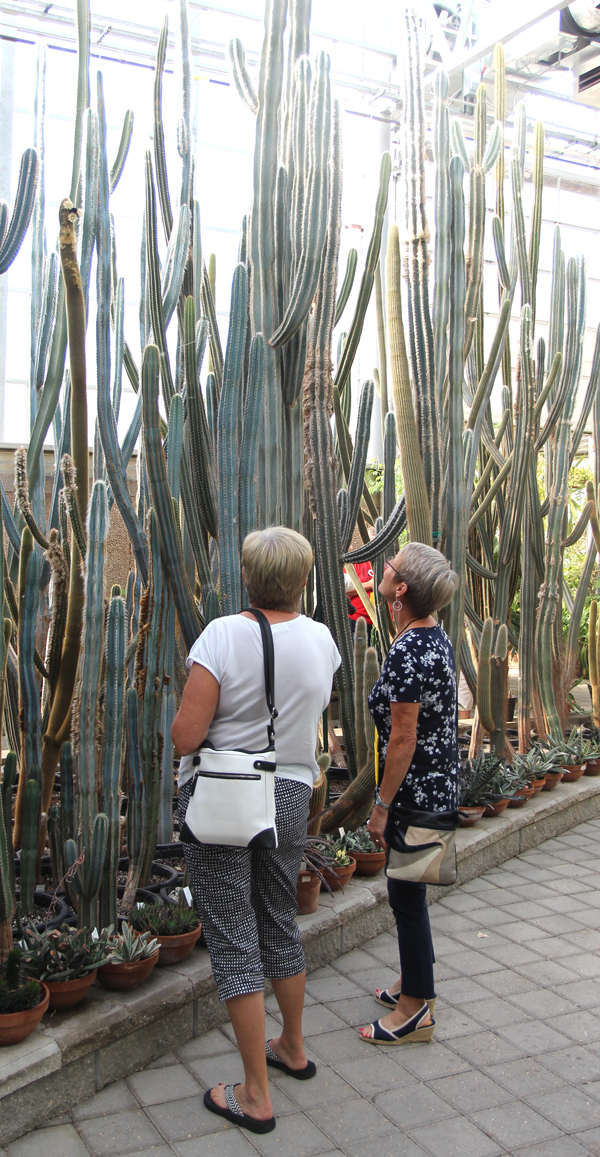
Vitko said he is still doing some collecting, but only of rare cacti that he has not been able to get as of yet, mainly barrel cactus. In some cases, these come from Mexico or South America, and may go extinct because their habitat is being lost. So collecting them is really keeping them living. He told a story about being able to get some seeds from a kid in Mexico in exchange for a cell phone, adding that the route to getting those seeds was an interesting one.
“I’m working on the rare stuff now. With the power of computers, you can find a guy to send you the seed. I’m narrowing the research to finding specific ones.”
Vitko told a few stories about varieties, including ones from Mexico that bloom at night and attract fruit bats. He also gave some tips for growing cacti and succulents for those interested. He said after the presentation that part of the attraction of these plants is they are easy to deal with.
“If they have sun, they are easy to take care of,” he explained. “If you are retired, you can do your yard in them, and you’re done. They will live hundreds of years.”
His presentation and collection made an impression. One of the CIB judges who will be known to Boissevainians is Hugh Skinner, who judged the community in the international category. He was wowed by the collection.
“It’s great to be here in the International Peace Garden in such an incredible setting,” Skinner said. “It is certainly one of the feature garden collections of cacti and succulents. You just have to look around at how beautiful it is.”
He said the CIB participants were being treated to different tours of the Garden while holding their conference. Skinner felt the area was perfect for the provincial celebration.
“This is a great place to host an event like this. The facilities are great; the food service is second to none. There is just lots to see and do here and it is of interest to a lot of people.”
Vitko said he is happy to see his collection thriving at the Peace Garden under Olwage’s skilled hand. He is sure the plants are at least 50% bigger than when he gave them up. Vitko admitted it was difficult to say goodbye to his life’s work, but everything is where it should be.
“It was tough to get rid of them,” Vitko stated, “But I’m really glad they’re here. You have to think they are alive because they are here. The cactus are just happy, and that makes me happy.”
by PAUL RAYNER, Recorder staff
PHOTOS BY ANNA LATIMER