
“It was a really tough decision. We have done a lot of research. It had been a lot of time that we researched. We have to look at it overall for the whole municipality.”
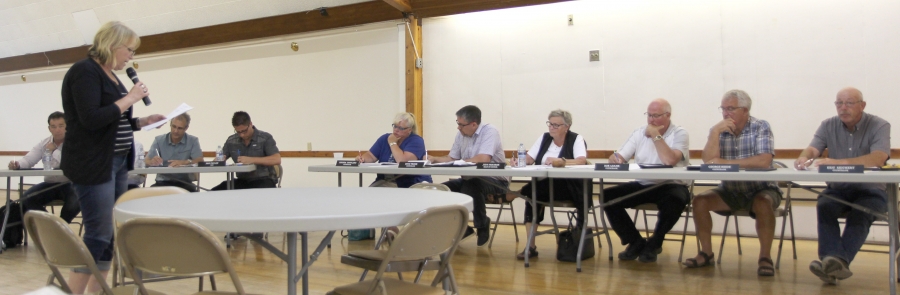
The Conditional Use Hearing, held at the Legion on July 2, was a well-attended affair and a public meeting necessary prior to passing a new livestock operation of this type. Head of Council Swanson opened the meeting, then turned it over to Don Malinowsky from Municipal Relations, who headed the Technical Review Committee. He explained the whole technical review process. He said an applicant does not just fill out a form and go from there. It takes several months to go through it. Malinowsky showed a “storyboard” with different “characters” – the applicant, the Province, the municipality and the public. The applicant files an application with the municipality, then it goes to the Province. The applicant has to fill out what he called a “daunting” application, it is submitted to the government, and it goes to different departments like Agriculture. They look for what Malinowsky referred to as “showstoppers” – things so badly wrong with the project it cannot proceed, such as not enough land or water. These would have to be dealt with by the applicant. After the pre-screening, an advertisement is put out for the public, as well as letters to landowners within three kilometers. Comments were sent to the proponent, and put on the Provincial website, along with the HyLife response. Once the Technical Review was completed at the end of May, it was sent to Boissevain-Morton Council to set a Conditional Use Hearing.
Speaking for HyLife, Sheldon Stott explained the project and the history of HyLife. He said the company was founded in 1994, and is headquartered in LaBroquerie. They operate in Manitoba, Saskatchewan and North Dakota with farms and feed mills. Presently, they do not operate in Boissevain-Morton but do in Killarney.
Their plans for Boissevain-Morton were a four-barn hog nursery on the south half of SE 34-04-20 WPM, about seven miles north of Boissevain and three miles west of #10 Highway. It would be a 24,000 head nursery (790 animal units). It would employ four full-time people. There would be an earthen manure storage facility and they would use 52,800 Imperial gallons of water a day, almost half from a proposed well. One feature was a three deep-planned shelterbelt of trees, which would help with smell. Stott also said keeping the barns clean will also deal with unpleasant scents. The use of manure would have to include soil testing before and after application.
“There is a significant amount of monitoring involved in this,” Stott stated, adding they have to get many licenses, including for water for the barns.
Stott said they were not planning to use municipal roads, but instead travel is to be kept on Highways #3 and 10 and Provincial Road #343. There would be three or four feed trucks and six to eight livestock trucks per week.
Malinowsky highlighted the report from his committee, which was accessible online. In Section C, he said HyLife had given all important information to all of the departments. They look at animal mortalities, soils, water usage, and separation distances to other land. Even with this, there are licenses and regulations that have to be met even should a project receive the okay from a municipality. From the technical perspective, the Province had no problem with the HyLife proposal.
Speakers from the public came next. Paul Bell of the manure applicator company RedHand, spoke in favour of the project. He discussed how his company has grown over the years, and how he has a good working relationship with HyLife. The hog industry is a highly regulated business, he said, and companies like HyLife help businesses like his own and others to expand.
“It takes employment opportunities like this to keep a community strong,” Bell said.
He was definitely in the minority. Several other speakers came forward to bring up objections. Some were from Boissevain-Morton, others from neighbouring Grassland, but all from around the site. Many objections were similar to each other. For many, the odour of a hog barn is something they did not want. Tom Sprott, who lives about three miles from the barn, said smell is the worst part, saying, “this is not a farm, it is a factory.” He added people in the area would not be able to sit on their decks in the short summer months.
Cathy Workman asked several questions of both the government and HyLife. One of these was whether or not the company would guarantee they would not use and destroy the municipal roads. Stott admitted they could not make such a guarantee, as the other roads could be unavailable.
Darren Peters, whose yard is about two miles from the site was worried about the smell, but also about the roads used. He said 343 would not be able to stand the heavy traffic, as it was one of the worst around this spring. Like many, he was also concerned that the landowners did not live in the area, so they would not have to deal with adverse effects. Also, like many, he brought up the fact the ownership of HyLife was no longer local, but in east Asia. He said ownership not being in the area could change the company priorities.
“The narrow benefits do not outweigh the wide negative effects,” Peters explained.
Trevor Martens asked the key question of all in attendance.
“Would you want this next to your place?”
In wrapping up, Stott told everyone about the benefits of the project. These included the business created by a $7 million building project, and the consumption of 6,000 tonnes of feed, most sourced locally. They would also pay around $11,000 per annum in taxes.
Conditions laid by the municipality include putting a cover on the manure storage by the end of 2023, contribute $25,000 per year to help with municipal road work. In the event non-PR roads are used, they must contribute 80% of the rebuild cost if damaged. HyLife must also meet with council once a year.
After hearing the decision, Stott was obviously pleased. He felt they had a good proposal, and were happy with the site they had. He said there is always a level of concern from the public when something comes into the neighbourhood, but added their track record is good and they have shown they can be good community partners. Opposition later becomes less of an issue once they see everything runs cleanly and smoothly. He added they have a lot of licensing to go, so they are unsure exactly when they will get started.
“Obviously, this is good news for us,” Stott said. “It is a great result and we look forward to being a part of the community.”
by PAUL RAYNER, Recorder staff